


Collaborations
The MILQ Lab partners with researchers around the world to advance human milk science. To date, we have contributed to over 30 international studies—spanning supplementation trials, fortification programs, cross-sectional research, and population-based surveys. In these collaborations, we serve as analytical experts for micronutrient analyses but are also consulted in other analylicatl goals, overseeing everything from sample handling and preparation to measurement and quality control. Our involvement often begins early, during grant development, where we provide detailed input on the analytical components needed to support the proposed research. In other cases, teams come to us after funding is secured, seeking our expertise in human milk analysis.

We stay engaged through the full arc of the project—from the analytical phase through dissemination—contributing to manuscripts and presentations and supporting clear, accurate interpretation of findings. "Our goal is to strengthen the analytical foundation of every collaboration—work that has contributed to a growing body of high-quality publications and presentations across the field.
Selected collaborative efforts
MOMI Consortium
The Multi-Omics for Mothers and Infants (MOMI) Consortium is a large global research initiative bringing together cohorts of over 24,000 pregnant women across Africa and Asia to better understand the biological drivers of adverse pregnancy outcomes such as preterm birth, preeclampsia, stillbirth, and poor fetal growth. Using a cutting-edge multi-omics approach—including genomics, metabolomics, proteomics, and nutrition analysis—the study integrates biological samples with clinical and socioeconomic data collected throughout pregnancy and after birth. By combining data across diverse populations and settings, MOMI aims to identify predictive biomarkers, uncover underlying biological pathways, and support the development of targeted diagnostics and interventions to improve maternal and infant health worldwide. As part of this collaboration, the MILQ Lab contributed analyses of B-vitamins, choline and related metabolites, and targeted metabolomics in maternal and cord blood samples, examining the effects of these adverse pregnancy outcomes on maternal nutrient status.
Selected publications:
- Xin Tang X, Ahmed S, Ahmed FB, Albrecht V, Brennsteiner V, Chang AL, Chowdhury NH, Deb S, Gormley M, Hasan T, Kamulaza L, Khalid J, Khan W, Khanam R, Kshetrapal P, Luo H, Maiti TK, Maitra A, Mannan MM, Mueller-Reif J, Mulenga C, Nisar I, Pervin J, Pokaprakarn T, Price J, Qazi MF, Rittenhouse K, Sebastiao Y, Sindano N, Sinha T, Sopory S, Steger M, Thiruvengadam R, Wadhwa N, Xue L, Aghaeepour N, Baqui AH, Bhatnagar S, Fisher S, Fox M, Hampel D, Kasaro M, Mann M, Rahman A, Sazawal S, Shenhav L, Stringer JSA, Zhang G, Jehan F, De Paris K. Multi-Omics for Mothers and Infants (MOMI) Consortium: a global initiative to study adverse pregnancy outcomes. Journal of Global Health, https://doi.org/10.7189/jogh.16.05002
MINE Project
The MINE (Maternal and Environmental Impact assessment on Neurodevelopment in Early childhood years) study, lead by Dr. Sidra Kaleem Jafri at Aka Khan Univeristy, is a 4-year longitudinal cohort study following mother-child pairs in peri-urban Karachi, Pakistan, to understand how maternal health, nutrition, and environmental adversity shape early brain development. Using MRI brain scanning, cognitive assessments, and biological samples collected yearly from infancy to age 3.5, the study aims to map neurodevelopmental trajectories in a low-income setting. The MILQ-Lab contributed by analyzing the nutrient composition of human milk samples — including macronutrients, choline, and vitamin B content — helping to clarify how early nutritional exposures through breastfeeding influence infant brain development and cognitive outcomes.
Selected Publications:
Parkar S, Mazhar N, Sharafat S, Ganny H, Afshan G, Memon S, Wahab K, Hotwani Aneeta, Hampel D, Jafri SK (2026); Association Between Breastmilk Targeted Metabolites and Maternal Characteristics: Targeted Metabolomic Profiling of Human Milk in Low-Income Settings. Metabolites, https://doi.org/10.3390/metabo16030162
DHM Study
Investigating Donor Human Milk Composition is a global, multi-site study, led by Dr. Maryanne Perrin at the University of North Carolina, bringing together researchers and human milk banks across eight countries to better understand the nutritional composition of donor human milk and improve care for preterm infants. By analyzing milk from 600 donors across diverse geographic and economic settings, this collaborative effort has generated one of the most comprehensive datasets on donor milk to date, examining nutrients, bioactive components, and the impact of milk banking practices such as pooling and fortification. The study aims to develop evidence-based strategies to reduce variability and ensure donor milk meets the nutritional needs of vulnerable infants worldwide. As part of this collaboration, the MILQ-Lab provided the analytical support for human milk micronutrient profiling.
Selected publications:
- Smith RM, Richter S, Iwayemi E, Mansen K, Israel-Ballard K, Hampel D, Shahab-Ferdows S, Allen LH, Bode L, Perrin MT (2025); Evaluating the Effect of Random Multi-Donor Pooling on the NutritionaVariability in Donor Human Milk Using Computer Modeling. Maternal & Child Nutrition, https://doi.org/10.1111/mcn.70158
- Perrin MT, Mansen K, Israel-Ballard K, Bode L, Hampel D, Shahab-Ferdows S, Allen LH, Maggio FC, Njuguna E, Tran HT, Wesolowska A (2025); Macronutrients, Vitamins, Minerals, and Bioactive Components in the Breast Milk of Approved Milk Bank Donors from Low- Middle- and High-Income Countries. American Journal of Clinical Nutrition, https://doi.org/10.1016/j.ajcnut.2025.07.031.
- Davis A, Lee S, Hampel D, Shahab-Ferdows S, Allen LH, Bode L, Mansen K, Israel-Ballard K, Perrin MT (2025); The Impact of Holder Pasteurization on Macronutrients, Vitamins, Minerals and Bioactive Factors in Human Milk Processed in a Milk Bank Setting. Current Developments in Nutrition, 9:107490, doi.org/10.1016/j.cdnut.2025.107490
Perrin MT, Mansen K, Israel-Ballard K, Richter S, Bode L, Hampel D, Shahab-Ferdows S, Allen LH, Mena P, Njuguna E, Tran HT, Wesolowska A. (2023); Investigating donor human milk composition globally to develop effective strategies for the nutritional care of preterm infants: Study protocol. PLOS ONE, https://doi.org/10.1371/journal.pone.0283846.
CoMIT
The CoMIT (Cubes of Micronutrients for Improved Nutrition) trial, led by Dr. Reina Engle-Stone at UC Davis, is a randomized controlled study designed to evaluate whether bouillon cubes fortified with multiple micronutrients can improve nutritional status in vulnerable populations in northern Ghana. Micronutrient deficiencies are common in this region, particularly among women of reproductive age and young children, and bouillon cubes offer a promising fortification vehicle due to their widespread daily use.
In this double-masked trial, households are randomly assigned to receive either micronutrient-fortified bouillon cubes—containing vitamin A, folic acid, vitamin B12, iron, zinc, and iodine—or control cubes fortified with iodine only. The study includes non-pregnant women of reproductive age, young children, and lactating women, with outcomes assessed over 3 to 9 months depending on the group. Primary outcomes include biomarkers of micronutrient status, hemoglobin concentrations, and—for lactating women—micronutrient levels in human milk. The MILQ-Lab provided analytical expertise for vitamin B12 quantification in blood and milk samples, contributing to the assessment of B12 status and its transfer into human milk.
Selected publications:
- TBA
IMiC Consortium
The International Milk Composition (IMiC) Consortium, led by Dr. Meghan B. Azad at the University of Manitoba, is a large-scale international collaboration analyzing human milk from over 1,000 mother-infant dyads across Canada, Tanzania, Pakistan, and Burkina Faso. The consortium integrates expertise in nutrition, global health, and data science to understand how human milk composition varies across diverse settings and how it influences infant growth and development. As part of this collabroative effort, our laboratory supported micronutrient profiling of the milk samples, quantifying B-vitamins, fat-soluble vitamins, and minerals across the four study populations.
Selected publications:
- Fehr K, Mertens A, Shu C-H, Espinosa C, Xue L, Mataraso S, Daily-Chwalibog T, Hubbard A, DeBoer MD, McDermid JM, Kolsteren P, Toe LC, Deng L, Shafiq Y, Muhammad A, Jehan F, Subarro P, Turvey S, Moraes T, Simmons E, Hampel D, Shahab-Ferdows S, Peymani P, Manus M, Bode L, Van Eyk J, Lagerborg K, Subramoney V, Kawle P, Pham M, Chooniedass R, Allen LH, Aghaeepour N, Rodriguez N, Azad MD (2025); Protocol: The International Milk Composition (IMiC) Consortium - a Harmonized Secondary Analysis of Human Milk from 4 Studies. Frontiers in Nutrition, 12:1548739; https://doi.org/10.3389/fnut.2025.1548739.
ELICIT
The ELICIT (Early Life Interventions for Childhood Growth and Development in Tanzania) study, lead by Dr. Mark D. deBoer at the University of Virginia, is a randomized, double-blind, placebo-controlled trial enrolling over 1,100 newborns in rural Haydom, Tanzania — a region where stunting affects roughly 70% of children by 18 months. The trial tests whether scheduled antimicrobials and daily nicotinamide supplementation can improve linear growth and cognitive development by 18 months of age. As part of this collaboration, the MILQ-Lab analyzed human milk B-vitamin profiles, enabling characterization of nicotinamide and other vitamin B3 vitamer secretion into breast milk throughout the study.
Selected publications:
- Wimborne EA, Hampel D, Allen LH, van der Veen DR, Panic G, Panchal M, Platt-Mills JA, Mduma E, Blacy L, Svensen E, Jatsoh S, Mdoe P, Scharf R, DeBoer MD, Swann JR (2025); Birth season shapes the infant metabolome and development in Tanzania: a secondary explorative analysis of The Early Life Interventions for Childhood growth and development in Tanzania (ELICIT) trial. Nature Communications, https://doi.org/10.1038/s41467-025-66268-9.
- DeBoer MD, McDermid JM, Hampel D, Shahab-Ferdows S, Mazzoni G, Peerson JM, Elwood SE, Scharf RJ, Jatosh S, Platts-Mills JA, Mduma E, Allen LH (2026); Human Milk Vitamin B3 (Niacin and Vitamer) Concentrations: Secondary Analysis of a Randomized, Placebo-Controlled Trial of Maternal Nicotinamide Supplementation in Rural Tanzania, American Journal of Clinical Nutrition, https://doi.org/10.1016/j.ajcnut.2026.101397
BMQ Study
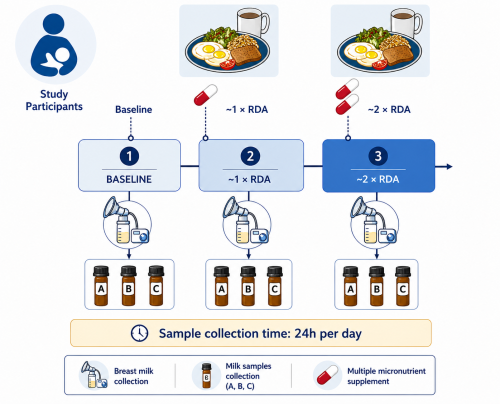
The MILQ Lab's Breastmilk Quality (BMQ) study, lead by Dr. Lindsay H. Allen and in collabroation with Dr. M. Munirul Islam at the icddr,b in Dhaka, Bangladesh, examined how different factors influence vitamin concentrations in human milk, with a focus on optimizing sample collection and analytical methods. We conducted a controlled study in Bangladesh with 18 lactating women, collecting milk samples over 24-hour periods under baseline conditions and following maternal vitamin supplementation at recommended and higher intake levels.
Milk was collected at every feeding and divided into multiple aliquots to assess how sampling methods affect nutrient measurements. The study quantified multiple nutrients—including B vitamins, vitamins A and E, and fat—allowing us to evaluate the effects of collection protocols, circadian variation, inter-individual differences, and short-term maternal supplementation on milk composition.
The findings highlight the importance of standardized sampling methods and provide insights into how maternal nutrition and timing influence the micronutrient content of human milk. This work also laid the analytical and methodological groundwork that directly informed the design of the MILQ study.
Selected puplications:
- Hampel D, Islam MM, Shahab-Ferdows S, Allen LH (2024); Human Milk Macro- and Trace Elements in Bangladesh and Their Response to Acute Maternal Supplementation. Current Developments in Nutrition, 8(Suppl.2):103736, https://doi.org/10.1016/j.cdnut.2024.103736.
- Hampel D, Shahab-Ferdows S, Islam MM, Peerson JM, Allen LH (2017); Variability of vitamin concentrations in human milk due to time within-feed, circadian rhythm and single-dose maternal supplementation. Journal of Nutrition, https://doi.org/10.3945/jn.116.242941.
BAN Study
The Breastfeeding, Antiretrovirals, and Nutrition (BAN) Study was a large randomized clinical trial conducted in Lilongwe, Malawi, designed to evaluate strategies to reduce mother-to-child HIV transmission through breast milk. The trial enrolled women living with HIV and their infants across six treatment groups, testing the efficacy of antiretroviral prophylaxis—administered to either mothers or infants—and nutritional supplementation during breastfeeding, as well as the feasibility of exclusive breastfeeding followed by early weaning. In this collaboration, the MILQ-Lab contributed human milk micronutrient profiling and characterized how antiretroviral treatment influenced nutrient transfer into milk.
Selected publications:
- Hampel D, Shahab-Ferdows S, Adair LS, Bentley ME, Flax VL. Jamieson DJ, Tegha G, Chasela C, Kamwendo D, Allen LH (2017); The effects of lipid-based nutrient and antiretroviral therapy on iron, zinc, and copper in human milk of HIV-infected Malawian mothers and their correlation to maternal and infantile biomarkers and characteristics. Maternal & Child Nutrition, https://doi.org/10.1111/mcn.12503 .
- Allen LH, Hampel D, Shahab-Ferdows S, York ER, Adair LS, Flax VL, Jamieson DJ, Tegha G, Chasela C, Kamwendo D, Bentley ME (2015); Antiretroviral therapy provided to HIV-infected Malawian women in a randomized trial diminishes the positive effect of lipid-based micronutrient supplements on breast milk B-vitamins. American Journal of Clinical Nutrition, 102, 1468-1474, https://doi.org/10.3945/ajcn.114.105106 .
- Flax VL, Adair LS, Allen LH, Shahab-Ferdows S, Hampel D, Chasela CS, Tegha G, Daza EJ, Corbett A, Davis N, Kamwendo D, Kourtis AP, van der Horst CM, Jamieson DJ, Bentley ME (2015); Plasma micronutrient concentrations are altered by antiretroviral therapy and lipid-based nutrient supplements in lactating HIV-infected Malawian women. Journal of Nutrition, 145, 1950-1957, https://doi.org/10.3945/jn.115.212290.
iLiNS Project
The International Lipid-Based Nutrient Supplements (iLiNS) Project is an international research collaboration, launched in 2008 and led by Dr. Kathryn G. Dewey at UC Davis, focused on preventing malnutrition in vulnerable populations. Building on earlier successes with lipid-based nutrient supplements (LNS) in Ghana and Malawi, the project conducted research in Burkina Faso, Ghana, and Malawi. Its work has centered on developing improved LNS formulations, testing their effectiveness through randomized controlled trials, and evaluating their impact on child growth, development, and maternal and infant nutrition. The project has also examined the economic aspects of LNS and aimed to share findings to support broader efforts to combat malnutrition worldwide. As part of this collaboration, the MILQ Lab provided analytical support and assessed B-vitamin concentrations in human milk from Ghanaian and Malawian mothers.
Selected publications:
- Adu-Afarwuah S, Lartey A, Okronipa H, Ashorn P, Zeilani M, Peerson JM, Arimond M, Vosti SA, Dewey KG (2015); Lipid-based nutrient supplement increases the birth size of infants of primiparous women in Ghana. The American journal of clinical nutrition. 2015;101(4):835-846, https://doi.org/10.3945/ajcn.114.091546.
- Ashorn P, Alho L, Ashorn U, Cheung YB, Dewey KG, Harjunmaa U, Lartey A, Nkhoma M, Phiri N, Phuka J, Vosti SA, Zeilani M, Maleta K (2014); The impact of lipid-based nutrient supplement provision to pregnant women on newborn size in rural Malawi: a randomized controlled trial–. The American journal of clinical nutrition. 2014;101(2):387-397, https://doi.org/10.3945/ajcn.114.088617.
List of additional collaborations
Over the years, we have contributed to a wide range of collaborative research projects by providing expertise in biomarker and micronutrient assessment. While these studies are not described individually here, they have collectively advanced our understanding of maternal and child nutrition, as well as nutritional health across diverse populations, and fostered productive partnerships across institutions. A selection of these collaborations, including the primary collaborator(s), is highlighted below.
Supplemetation Trials
- SISTIK Growth Study: Chicken liver and eggshell crackers as a safe and affordable animal source food for overcoming micronutrient deficits during pregnancy and lactation in Indonesia (Aly Diana)
- LAO Thiamine Study: Establishing a case definition of thiamine responsive disorders among infants and young children in Lao PDR (Sonja Y. Hess)
- Low-dose thiamine supplementation of lactating Cambodian mothers (Kyly C. Whitfield)
- Maternal lipid‐based nutrient supplement and infant micronutrient intake in Guatemalan women and infants (Juliana A, Haber)
- Early Nutrition and Immune Development (ENID) trial: A randomized trial to investigate the effects of pre-natal and infant nutritional supplementation on infant immune development in rural Gambia (Sophie E. Moore)
- Perinatal Consumption of Thiamine-Fortified Fish Sauce in Rural Cambodia (Kyly C. Whitfield, Timothy J. Green)
- Vitamin B12 Supplementation of Bangladeshi Women in Pregnancy and Lactation (Towfida Siddiqua, Lindsay H. Allen)
- JiVitA Bangladesh study; JiVitA-3 (Parul Christian, Kerry Schulze)
- Metabolic profile in vitamin B-12 deficiency and repletion and neurological function in elderly adults (Alex Brito, Lindsay H. Allen)
Surveys/Observational/Cross-sectional Studies
- MOM2CHild: Leveraging Systems Biology toward Discoveries in Maternal Obesity, Milk, and Translation to Child Health (Laurie Nommsen-Rivers)
- The Childhood Acute Illness & Nutrition Network (CHAIN); Undernutrition in Infancy (Martha Mwangome, James A Berkley, Christine McGrath)
- Madagascar Health and Environmental Research–Antongil (MAHERY–Antongil) Study (Christopher D. Golden)
- Prevalence of micronutrient deficiencies across diverse environments in rural Madagascar (Christopher D. Golden)
- Micronutrient adequacy of exclusively breastfed Indonesian infants (Lisa Daniels, Lisa A. Houghton)
- Vitamin B12 status in milk of vegan, vegetarian, and nonvegetarian women in the United States (Roman Pawlak, Maryanne T, Perrin)
- Vitamin B12 and folate status of Norwegian vegans and vegetarians (Sigrun Henjum)
- Anemia, Micronutrient Deficiencies, and Malaria in Children and Women in Sierra Leone (James P. Wirth)
Fortification Projects
- Wheat flour fortification in Cameroon (Reina Engle-Stone, Kenneth H. Brown)